2026’s Unreplayable Gaming Legends: You Play Once, Then It’s Game Over Forever
Single-play games like You Only Live Once use browser history to enforce permanent consequences, still shocking players in 2026.
In this glorious, hyper-connected year of 2026, the gaming landscape is a remastered, re-released, replay-crazy beast where completionists and trophy hunters grind every path, every ending, every microscopic pixel of content until their thumbs bleed. From sprawling AAA open-world epics to cozy indie gems, the mantra screams “new game plus” louder than a caffeinated Twitch streamer. But hold your horses, pilgrim—there exists a legendary, unrepentant breed of games that completely flips the bird at the replay obsession. These digital outliers don’t just discourage a second playthrough; they actively punish, prevent, or ontologically delete the possibility of ever going back. They are the final bosses of commitment, whispering “you only live once” straight into your soul. Even in 2026, the community still can’t stop talking about these audacious masterpieces that demand your one and only shot.
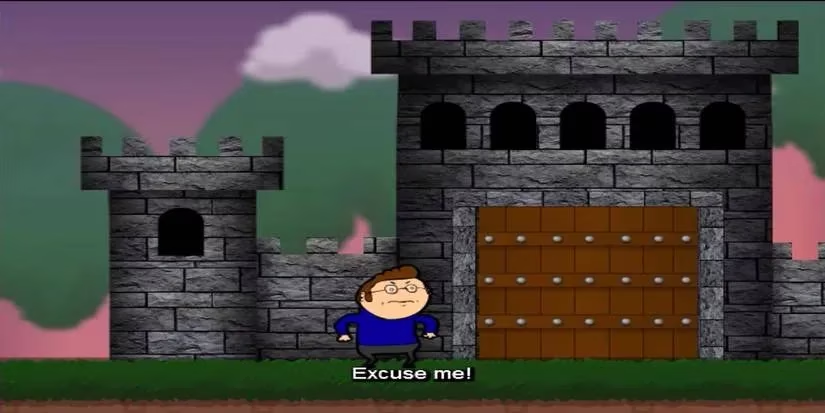
The holy grail of this irreverent concept is, without doubt, the infamous Flash game You Only Live Once (2009). Picture this: a pixelated dude named Jemaine strolls into a castle to rescue his girlfriend from Sir Giant Pink Lizard—standard platformer cheese, right? Wrong. The devs decided to weaponize the entire browser history. One death, and bam, your journey is toast. No retry button, no checkpoint wizardry, just the haunting stillness of Jemaine’s grave. Unless you went full CIA mode and purged your browser data, the game locked you out forever. In 2026, relics of the Flash era are still worshipped like arcane crypts, and YOLO (literally) is the granddaddy of “no take-backsies” gaming. Ain’t no second chances here, buddy.
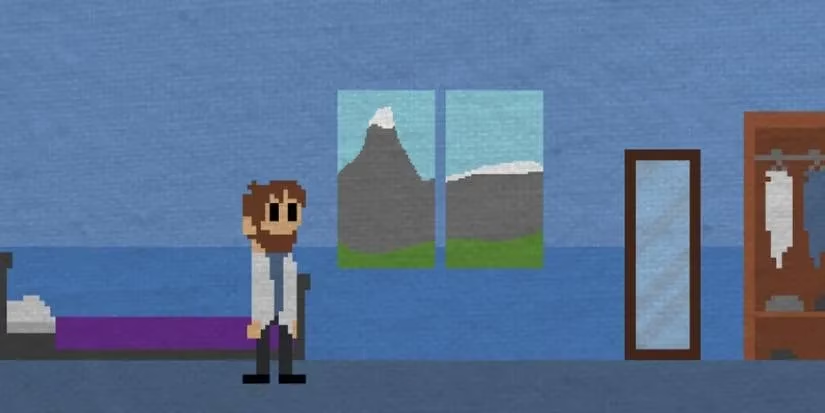
Then there’s the psychological landmine One Chance (2010), another Flash artifact that harnessed browser history to enforce the cruelest ultimatum. Dr. John Pilgrim, the poor sap, accidentally unleashes a cancer cure that annihilates all living cells. You have six in-game days to grope for a solution. Whatever ending you stumble into—hero, failure, or empty grave—that’s your eternal reality. The game effectively grabs your shoulders and shouts, “Live with it, champ!” In today’s save-scumming era, the audacity of making you own your choices hits differently. It’s like the ultimate mic drop before browser games vanished into the internet’s memory hole.
Fast-forward to the underground nightmare Milya[broken], crafted by the twisted genius behind the Yume Nikki fangame .flow. This 2020s meta-horror puzzle experience forces you to dig through actual game files, solve grotesque riddles couched in deliberately broken English, and eventually delete the entity Milya to end the madness. But wait—sit on the black ending screen long enough, and she returns for one last heart-stopping message before the game permanently seals itself shut. It’s the kind of “trust me, you’re done here” closure that sends shivers down your spine and makes 2026 lore hunters foam at the mouth. No reload, no reinstall, just a spectral voice and eternal silence. Talk about commitment issues.
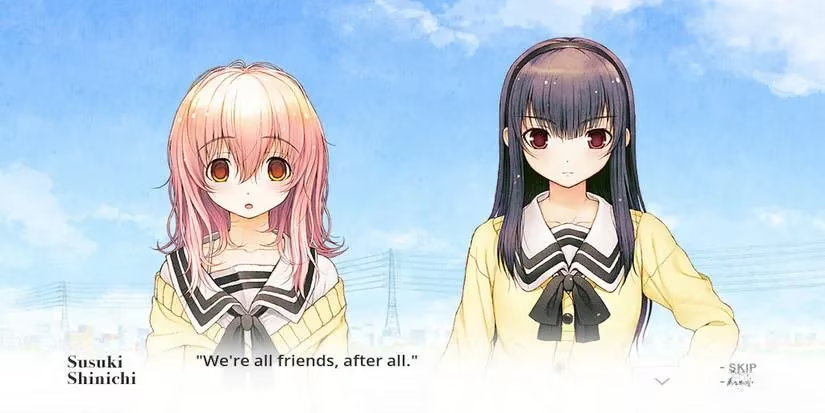
Dating sim enthusiasts learned the hard way with YOU and ME and HER: A Love Story (2013), the grand precursor to Doki Doki Literature Club’s psychological warfare. On the surface, it’s a vanilla high school romance with childhood friend Miyuki and class outcast Aoi. Choose Aoi’s route after Miyuki’s, and all hell breaks loose—Miyuki literally corrupts the game, stares through the screen, and forces a catastrophic choice. Save one girl, uninstall the entire game if you want to erase the guilt, otherwise your decision is carved into your save file like a scarlet letter. Even in 2026, visual novel fans whisper tales of this trauma like a campfire horror story. The game’s like, “You wanted a harem route? Bless your heart—here’s a therapy bill instead.”
1997’s lost gem Moon: Remix RPG Adventure finally got its global release in 2020 and directly inspired Undertale’s pacifist shenanigans. You play a kid sucked into an RPG world where the “hero” has been a total menace—looting houses, slaughtering innocent monsters. Your job? Clean up his mess by healing the damage. The kicker? To truly save the world, you must literally quit the game entirely. Yup, the ultimate good ending requires you to stop playing. In 2026, this anti-RPG still provokes esoteric YouTube video essays like “The Philosophy of Quitting” and drives completionists absolutely bonkers. It’s as if the game pats you on the head and says, “You did good, kiddo. Now go touch grass.”
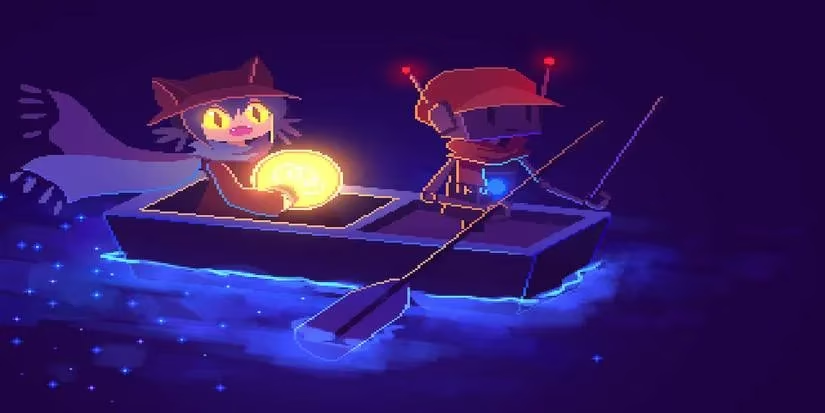
The aptly named OneShot (2016 remaster) elevates the one-and-done philosophy to an art form. Niko, a cat-child carrying a light bulb sun, directly speaks to you, the player, as a separate character. The original 2014 version would destroy the world if you merely closed the window. In the paid release, you can “replay” by deleting the save file, but that action itself triggers new meta narrative leading to the true ending—which can only be experienced once. By 2026, OneShot has become the poster child of “games as a personal memory,” where your single journey with Niko becomes a cherished, unrepeatable relic. Solstice runs are whispered about like ghost stories, and the community fiercely protects the sanctity of that unique bond. Ain’t no save-scumming to see every ending; you get one shot, make it count or regret it forever.
Then enters the super-stylish, time-bending FPS Superhot (2016), where time only moves when you do. While the minimalist red-and-white violence is addictive, the metafictional layer goes full Skynet. The game within the game warns you that “superhot.exe” is too dangerous, that it’s bleeding into reality. Once you realize the system is monitoring you, the only true victory is to quit the game entirely and never touch it again—otherwise, you become one with the program. In 2026, Superhot’s legacy as a commentary on gaming addiction and agency remains razor-sharp; streamers still dramatically uninstall it live, declaring “I’m not a part of your system!” It’s the most badass way to “beat” a game: by walking away forever.
No list of unreplayable nightmares is complete without Doki Doki Literature Club! (2017), the freeware visual novel that broke the internet. Disguised as a bubbly dating sim, it lures you into the literature club with Monika, Sayori, Yuri, and Natsuki. Then, the poetic glitches start, save files get corrupted, and Monika reveals she’s been pulling the strings all along. Each “reset” is actually part of one continuous run, and the final choice forces you to accept consequences that persist across all data until you literally delete Monika’s character file. By 2026, the DDLC community still debates the ethics of replaying; purists insist that your first and only organic experience is the canon truth. It’s the ultimate commitment check that turned a generation of gamers into paranoid file explorers.
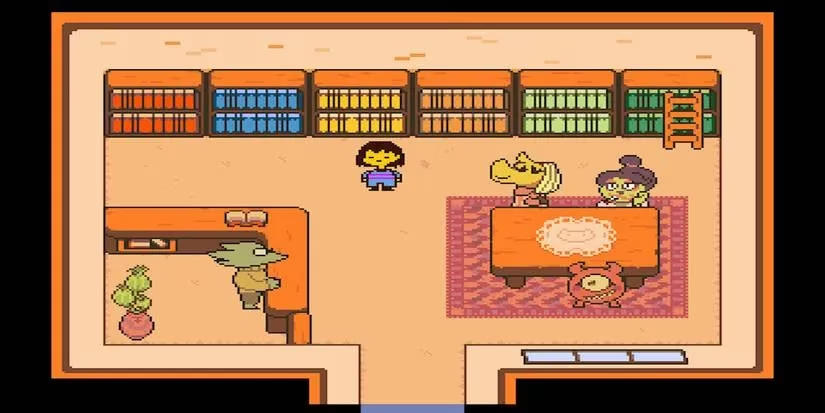
And how could we forget the elephant in the room—Undertale (2015)? After Frisk’s journey through the Underground, whether you massacred everyone or became their best friend, the true pacifist ending begs you to let the monsters live their happy ever after. Flowey himself pleads with you not to reset. Yet the game doesn’t physically prevent you, but the emotional weight is so catastrophic that most players can’t bring themselves to erase the happy memories. In 2026, Undertale remains a cultural touchstone for “one true playthrough” philosophy; those who dare to reset are regarded with the same horror as someone who kicks puppies. The Genocide route’s permanent stain on your save file is a scarlet letter of shame that follows you across reboots.
Honorable mention goes to Daniel Mullins’ unholy arcade demon Pony Island (2016), where you hack into a possessed cabinet to save your soul. After endless runner sections and code tampering, the trapped soul begs you to uninstall the game so they can truly be free. Beat it, delete it, and never look back—the ultimate act of digital exorcism. And let’s not forget the solemn Moon-like ritual of just closing the app forever. These games don’t want your replay dollars or your Twitch marathons. They want your singular, authentic experience to become a permanent part of your gamer history.
So here we stand in 2026, with teraflops of power and infinite replayability at our fingertips, yet these unyielding masterpieces hold more cultural weight than ever. They remind us that sometimes, the most powerful gaming experience is the one you can never have again. Embrace your choices, shed a tear, and move on—because in these games, there’s no new game plus, only the wistful ghost of what once was. And frankly, that’s metal as hell. 🤘
This overview is based on reporting from Polygon, and it helps frame why “play-it-once” titles still hit so hard in 2026: they’re designed less like products to be optimized and more like experiences that deliberately collapse the distance between player, save file, and consequence. Read through the lens of gaming culture (not just mechanics), games like One Chance, OneShot, and DDLC turn permanence into the core feature—making your first run feel like a personal canon rather than one branch among many, and making the urge to replay feel like an intrusion instead of a completionist flex.
0 Comments