Modern Video Games Challenge Traditional Hero Narratives Through Complex Antiheroes
Exploring video game antiheroes and character morality, this article unveils compelling, thought-provoking narratives that challenge traditional heroism.
In an era where storytelling in video games has reached unprecedented sophistication, a significant shift has occurred in how developers approach character morality. While traditional narratives often present clear distinctions between good and evil, contemporary titles increasingly explore the murky, morally ambiguous territory that lies between these extremes. This evolution reflects a broader cultural appetite for complex protagonists whose motivations are as layered and contradictory as real human psychology. The trend toward antiheroes—characters who operate outside conventional heroic frameworks—has produced some of gaming's most memorable and thought-provoking experiences, inviting players to question not only the nature of heroism but also their own ethical boundaries.
🎭 The Bard's Tale: Satirizing Heroic Archetypes
The Bard's Tale stands as a brilliant deconstruction of fantasy conventions through its irreverent protagonist, who approaches quests with the reluctant enthusiasm of a cat being asked to take a bath. This isn't your typical noble warrior—the Bard's primary motivations include self-preservation, monetary gain, and avoiding responsibility whenever possible. The game's narrative consistently lampoons traditional fantasy tropes, presenting a world where the forces of "good" are often as problematic as the evils they oppose. Through witty dialogue and satirical scenarios, the game challenges players to reconsider what truly constitutes heroism in a world where moral clarity is as elusive as a coherent government policy.
👑 Overlord: Cartoon Evil with Philosophical Depth
On its surface, Overlord appears to celebrate cartoonish villainy, with players commanding hordes of mischievous minions to terrorize villages. However, beneath this playful exterior lies a surprisingly nuanced examination of morality. The game presents a world where traditional fantasy races have become grotesque parodies of themselves: halflings transformed into gluttonous monsters, elves corrupted by dark magic, and dwarves obsessed with wealth accumulation. In this context, the player's destructive actions sometimes feel more like necessary corrections than random evil. The game poses uncomfortable questions about whether imposing order through force is truly worse than allowing natural decay to continue unchecked, making the player's moral position as slippery as a politician's promise.
🏫 Bully: Navigating Adolescent Morality
Rockstar's Bully presents the complex social ecosystem of a boarding school through the eyes of troubled teenager Jimmy Hopkins. The game masterfully subverts expectations about school archetypes: the "nerds" are vindictive schemers, the "jocks" possess unexpected depth, and the authority figures are often more problematic than the students they're supposed to guide. Players navigate this morally ambiguous landscape, deciding whether Jimmy will become part of the system's corruption or attempt to reform it from within. The game suggests that adolescent morality operates in shades of gray, where small acts of kindness can exist alongside questionable behavior, much like a mosaic where beautiful tiles are interspersed with broken fragments.
⚔️ God of War: The Evolution of a Destroyer
Kratos's journey across the God of War series represents one of gaming's most profound character transformations. Beginning as a Spartan warrior seeking revenge against the gods who betrayed him, Kratos gradually becomes the very thing he initially sought to destroy—a being whose rage causes catastrophic collateral damage. The original Greek mythology games present gods who are capricious and self-serving, while Kratos himself becomes increasingly monstrous in his pursuit of vengeance. This trajectory raises uncomfortable questions about whether the desire for justice can corrupt as thoroughly as the original injustice, turning the protagonist into a moral black hole that consumes everything in its path.
🚗 Grand Theft Auto V: Criminality with Character
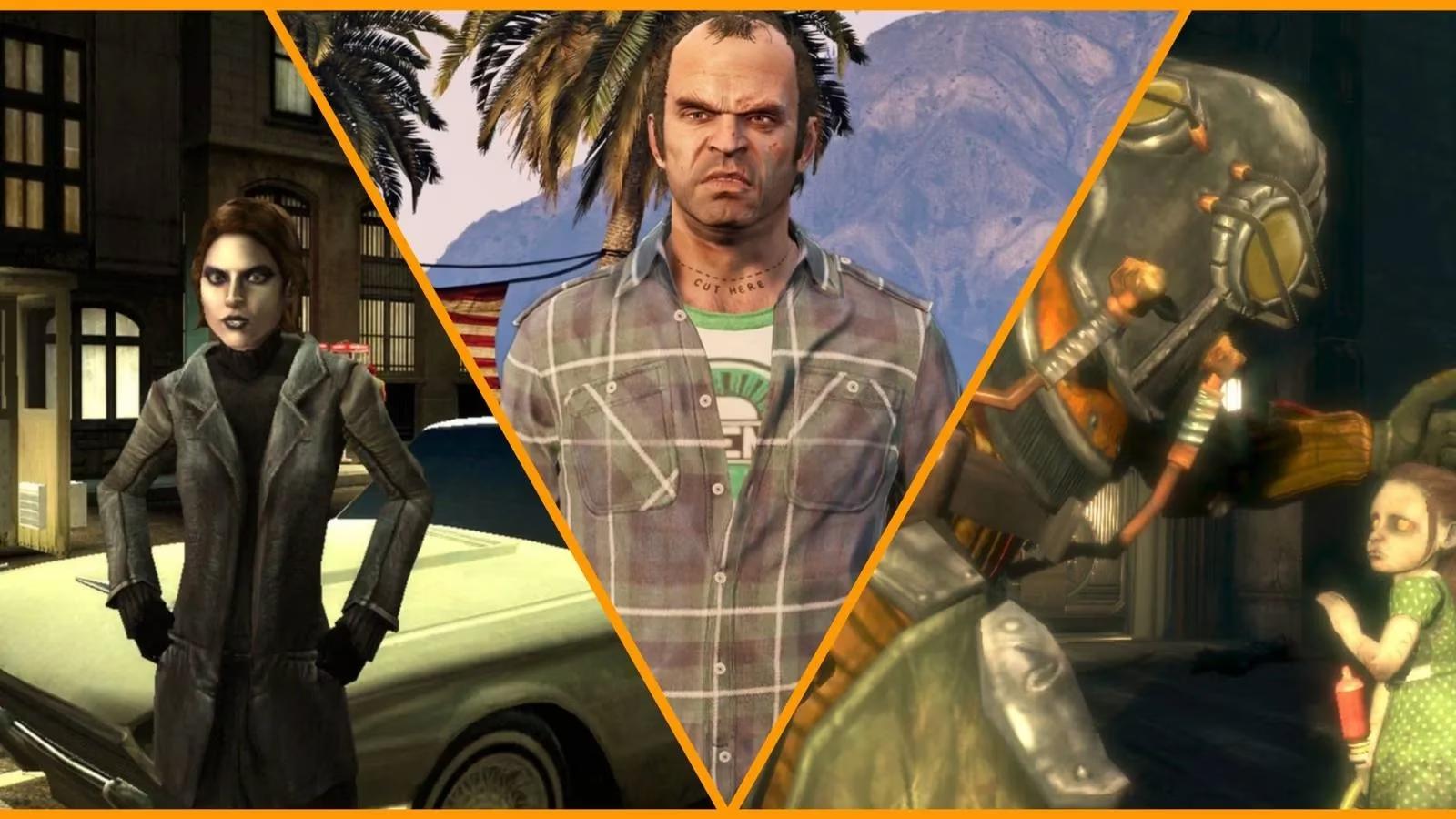
The Grand Theft Auto series has long specialized in morally ambiguous protagonists, but GTA V elevated this tradition by presenting three distinct antiheroes with interwoven narratives. Michael represents the compromised family man whose criminal past constantly threatens his present stability. Franklin embodies the ambitious outsider navigating systemic barriers through questionable means. Trevor serves as the id unleashed—a chaotic force of nature whose unpredictability makes him simultaneously terrifying and compelling. Together, these characters create a tapestry of modern criminality that feels disturbingly relatable, suggesting that in a broken system, traditional morality becomes as practical as using a teacup to bail out a sinking ship.
| Character | Primary Motivation | Moral Complexity |
|---|---|---|
| Michael | Family stability and wealth | Tries to balance criminal life with family values |
| Franklin | Upward mobility and loyalty | Navigates systemic inequality through illegal means |
| Trevor | Pure chaotic self-interest | Represents the id without societal constraints |
🎭 Dishonored: Revenge in a Morally Blurred World
Dishonored presents a revenge narrative where moral certainty dissolves with each new revelation. Protagonist Corvo Attano operates in a world where allies become betrayers, and apparent villains sometimes offer unexpected assistance. The game's chaos system—where the world becomes progressively darker based on the player's violent actions—creates a direct correlation between gameplay choices and narrative consequences. Even the mysterious Outsider, who grants Corvo supernatural abilities, operates in an ethical gray zone, neither clearly good nor evil. This creates a narrative experience where moral navigation feels like walking through a house of mirrors—every reflection distorts reality, making it impossible to trust what you see.
🧛 Vampire: The Masquerade – Bloodlines: Humanity Through Monstrosity
Vampire: The Masquerade – Bloodlines explores morality through the lens of supernatural existence, asking what it means to retain humanity while possessing inherently monstrous needs. Players navigate complex political intrigues within vampire society while managing their character's hunger for blood—a mechanic that creates constant tension between survival and ethical behavior. The game presents vampire factions with conflicting ideologies, none of which offer morally pure positions. This narrative framework suggests that morality isn't about avoiding darkness but about navigating it with intention, much like a tightrope walker maintaining balance despite shifting winds.
🌼 Undertale: Player Choice as Moral Determinant
Undertale revolutionized narrative gaming by making player choice the central determinant of both story and character morality. The game's famous pacifist, neutral, and genocide routes create radically different experiences based on whether players choose violence or mercy. Characters who might be enemies in one playthrough become allies in another, with the game's memorable cast developing along paths determined by player decisions. This creates a powerful statement about how our actions shape not only outcomes but the very nature of the people around us, suggesting that morality isn't fixed but fluid—as changeable as water taking the shape of its container.
🌊 BioShock: The Illusion of Agency
BioShock's famous "Would you kindly?" revelation represents one of gaming's most brilliant narrative twists, fundamentally challenging player agency and moral responsibility. The revelation that protagonist Jack has been manipulated through psychological conditioning transforms what appeared to be voluntary actions into programmed responses. This narrative device forces players to reconsider every previous decision, questioning whether true moral choice was ever possible within the game's framework. The decaying underwater city of Rapture serves as a perfect metaphor for this moral ambiguity—a beautiful utopian vision corrupted from within, where distinguishing creator from destroyer becomes increasingly difficult.
🔮 The Future of Moral Complexity in Gaming
As video game narratives continue to mature, the trend toward morally complex characters shows no signs of slowing. Recent titles and those anticipated for 2026 suggest developers are increasingly interested in creating protagonists who defy easy categorization, reflecting the nuanced moral landscapes of contemporary life. This evolution represents gaming's growing confidence as a narrative medium capable of exploring philosophical questions with sophistication and emotional depth. By presenting players with difficult choices and morally ambiguous scenarios, these games do more than entertain—they invite reflection on the nature of morality itself, proving that sometimes the most heroic act is acknowledging that simple answers rarely exist for complex questions.
0 Comments