My Journey Through Video Games Where Combat Is Optional: A Pacifist's Playground
Explore the revolutionary world of non-violent gaming with RPG masterpieces like Disco Elysium and Fallout: New Vegas, where your intellect and charisma become your ultimate weapons.
As I look back over my years of gaming, I've realized something about myself: I'm not always in the mood for a fight. From the pixelated blasters of Space Invaders to the modern, cinematic brawls, violence has been the default setting for so long that it feels baked into the very DNA of the medium. But here's the thing—some of my most memorable gaming moments have come from games that gave me a choice. Games that whispered, "You don't have to fight your way through this." It's 2026, and I'm thrilled to see that this design philosophy isn't just a niche curiosity anymore; it's a legitimate and celebrated path. Let me take you on a tour of the virtual worlds where my words, my wits, and my sneaky boots were my greatest weapons.
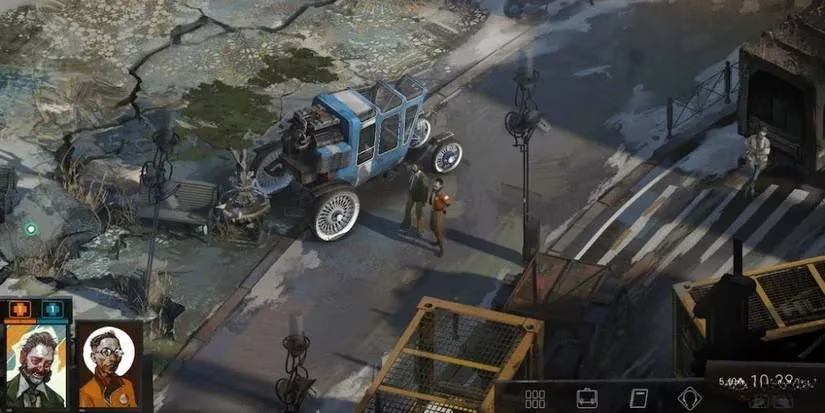
Let's start with the game that completely rewired my brain about what an RPG could be: Disco Elysium. This game, man, it's something else. It's the only CRPG I know that ditches combat entirely. Not a single sword swing or gunshot. Instead, your battlefield is the rain-soaked, politically-charged streets of Revachol, and your weapons are your skills—logic, rhetoric, drama, even your own volatile psyche. I spent hours just talking to my own necktie, for crying out loud! The game's phenomenal writing and deep RPG systems make every conversation feel like a high-stakes negotiation. You can be a brilliant detective or a dumpster-dwelling disaster, and the game never forces you into a brawl. It proved to me that a world can be utterly captivating without a single punch being thrown. It's a masterclass in letting story and character drive the engagement.
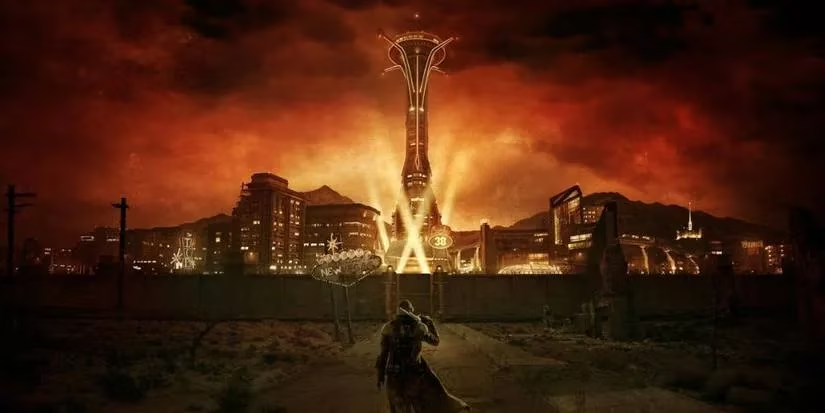
Now, if you want a game that gives you the tools for violence but rewards you for avoiding it, Fallout: New Vegas is the gold standard. Obsidian (they're the kings of this stuff, you'll see) crafted a Mojave Wasteland where speechcraft isn't just a side skill—it's a superpower. With enough Charisma and the right perks, you can talk your way out of almost any confrontation. I remember facing down a gang of heavily armed raiders, my heart pounding, only to smooth-talk them into letting me pass and even giving me a discount on their junk. It felt incredible! The VATS combat is still there if you want that gory, slow-mo satisfaction, but the real magic is in the multi-layered quest design that always seems to have a diplomatic solution tucked away if you're clever enough to find it.
Speaking of classics, Planescape: Torment is the granddaddy of the "talk-first" RPG. This Enhanced Edition still holds up remarkably well. By investing in Intelligence and Charisma, you can reason, bluff, and philosophize your way past demons, zombies, and other planar weirdos. I think there are, like, maybe four unavoidable fights in the entire epic campaign. The rest? Pure cerebral role-playing. It requires some lucky dice rolls, sure, but the feeling of outsmarting a literal god with a well-placed argument is unmatched. It taught me that in a world of infinite doors, the key is often just the right words.
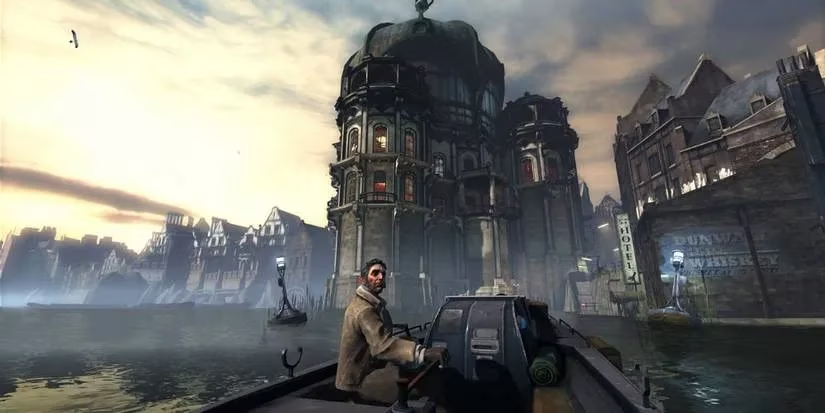
For a more action-oriented but still pacifist-friendly experience, Dishonored is a stealth masterpiece. The game doesn't just allow non-lethal play; it actively encourages it. You can spare every single assassination target, using sleep darts and blink powers to navigate Dunwall like a ghost. And get this—the world literally becomes a nicer, less plague-ridden place if you keep your blade clean. Fewer guards, fewer rats, a brighter ending. It’s a game that made me feel like a virtuoso of shadows, where success was measured in silence, not corpses. Corvo Attano, a Milford man indeed (no one was to know he was there!).
Obsidian makes another appearance with The Outer Worlds. This spacefaring adventure is a riot of corporate satire, and while you can blast your way through it with fun, zany weapons, you can also be the galaxy's smoothest talker. By exploring, building rapport with factions, and understanding each quest's nuances, I found peaceful resolutions to most conflicts. Sure, you can't reason with a charging primal beast, but in the civilized (if corrupt) corners of Halcyon, my silver tongue was my best weapon. It's a criminally short game, but every moment of my diplomatic playthrough felt meaningful and packed with personality.
Then there's Kingdom Come: Deliverance, which grounds its non-violence in brutal realism. You play as Henry, a blacksmith's son, not a superhero. Early on, trying to fight every bandit is a sure way to get a sword through your gut. The game forced me to use my brain—to barter, to persuade, to run away! You can complete almost the entire story without killing anyone (and even get a shiny achievement for it). The final showdown is unavoidable, but the journey there is a testament to the power of cunning over brute force. It made me appreciate that sometimes, the bravest thing you can do is walk—or sprint—away.
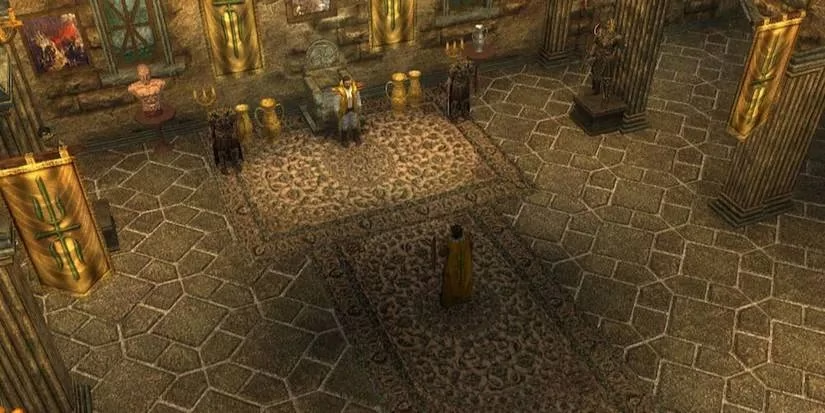
For the true CRPG masochists, The Age of Decadence is the ultimate test. This game is an odd duck, no doubt about it. It throws you into a harsh, post-apocalyptic Roman-esque world as a completely ordinary person. To survive without combat, you basically must be a Loremaster or a Merchant, using intelligence, perception, and social maneuvering to navigate its treacherous political landscape. The combat system is deep, but the game supports—and almost dares you to try—a full pacifist run. It's divisive and brutally difficult, but pulling off a non-violent playthrough here feels like a genuine intellectual triumph.
Of course, no list like this is complete without Undertale. Toby Fox's masterpiece is built around the choice to fight or befriend. The game's heart lies in its pacifist route, where you solve puzzles, share jokes, and show mercy to every monster you meet. Engaging with the bullet-hell combat to peacefully resolve encounters is uniquely satisfying. It's a game that rewards empathy with deeper character connections and a profoundly moving story, while actively punishing mindless violence. It’s a beautiful lesson packaged in a deceptively simple game.
A newer favorite of mine is Citizen Sleeper. This narrative-driven RPG set on a dilapidated space station has no combat whatsoever. Your life as a runaway android is measured in dice rolls, daily choices, and building relationships to secure a future. The tension comes from managing your deteriorating body, helping your friends, and evading your past. It's all text and dice, but I was on the edge of my seat the whole time. It proves that stakes don't need to be life-or-death combat; they can be the fear of losing your found family or your last chance at freedom.
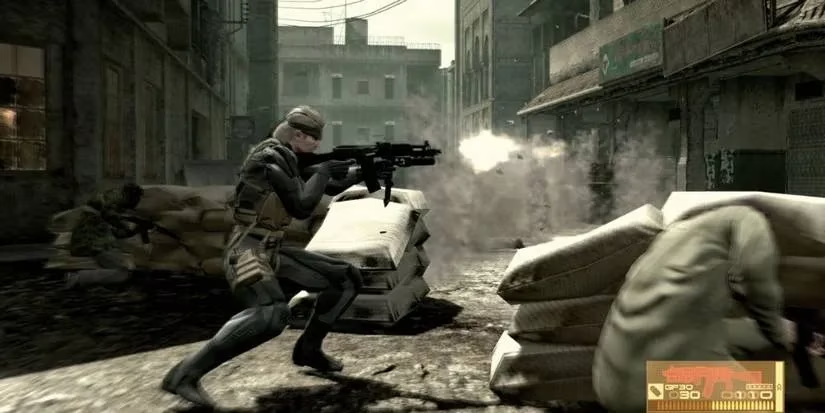
Finally, I have to tip my bandana to Metal Gear Solid 4: Guns of the Patriots. While earlier games in the series often required sneaky kills, this one gave me an arsenal of non-lethal options: tranquilizer darts, stun grenades, and CQC knockouts. I slinked through war zones with a zero-body-count goal, and the game rewarded that restraint. It punished reckless aggression, making stealth and patience the true paths of the legendary soldier. It was a fitting capstone to Solid Snake's story, showing that even in a world gone mad with war, a single person can choose not to add to the body count.
So, what have I learned from my pacifist pilgrimages? That games are at their most powerful when they reflect the full spectrum of human conflict—not just the physical, but the social, intellectual, and moral. These games trust the player to find their own path and often reward that creativity with richer stories and more meaningful connections. In 2026, I'm grateful that more developers are embracing this design, offering sanctuaries for us lovers, not fighters, to play our way. Now, if you'll excuse me, I have a date with a dumpster in Revachol and some very important thoughts to discuss with my necktie.
0 Comments