The Haunting Echoes of Choice: My Journey Through Gaming's Darkest Secret Endings
Dive into chilling video game endings and secret consequences, uncovering haunting truths that redefine the hero's journey in gaming.
As I sit here in 2026, reflecting on decades of gaming, I realize the stories that stick with me aren't always the triumphant ones. They're the ones hidden in the shadows, the conclusions you have to fight to see, or sometimes, fight to avoid. Most games offer a clear path—a hero's journey with a satisfying resolution. But the ones that truly burrowed into my psyche were those that dared to hide their bleakest truths behind layers of player action and inaction. These aren't just endings; they're consequences, grim reflections of choices made in digital worlds that somehow feel all too real. I've chased these shadows, and the journey has changed how I see every game I play.
My first real brush with this chilling concept came with the original Shenmue. We all remember the frustration, the promise of a grand revenge tale that seemed perpetually out of reach. For years, I, like everyone else, followed Ryo's quest. But then I learned of the secret. The one you get not by moving forward, but by standing still. By letting Ryo linger in Dobuita, refusing to chase Lan Di, until a full year passes. On that fateful April 15th, history doesn't just rhyme—it repeats. Lan Di returns, and Ryo meets the exact same brutal fate as his father. No sequel hook. No hope. Just a cold, final period on a story I thought was about beginnings. It taught me that sometimes, the bravest thing a hero can do is fail, and that a game world can continue its cruel cycle with or without your intervention.
The theme of chilling indifference was taken to a whole new level in Shadow Complex. Here I was, Jason, with my girlfriend Claire kidnapped by a militant separatist group planning to plunge America into civil war. The game paints you as the reluctant hero. But what if you just… didn't want to be? I'll never forget the hollow feeling of turning my back. Instead of descending into the caverns, I fought my way out, back to the jeep. One button press, and Jason drove off into the sunset with a callous, "Eh, plenty of fish in the sea." The modern remaster even rewards this moral bankruptcy with a trophy: "Status Update: Single." It's a brutal commentary on player agency—the power to be not just a bad hero, but a genuinely terrible person.
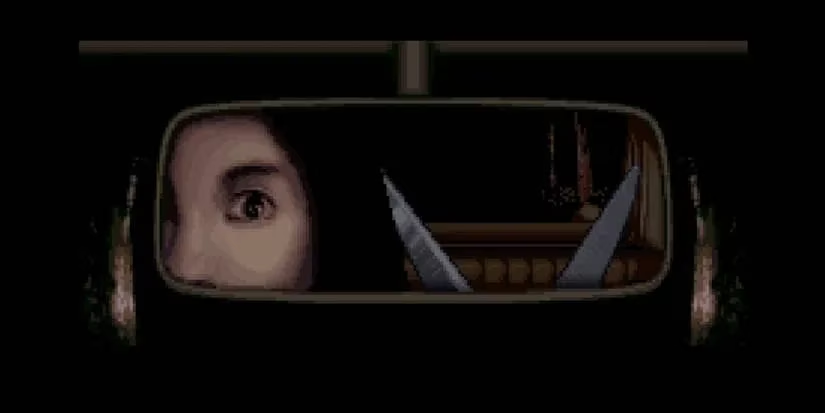
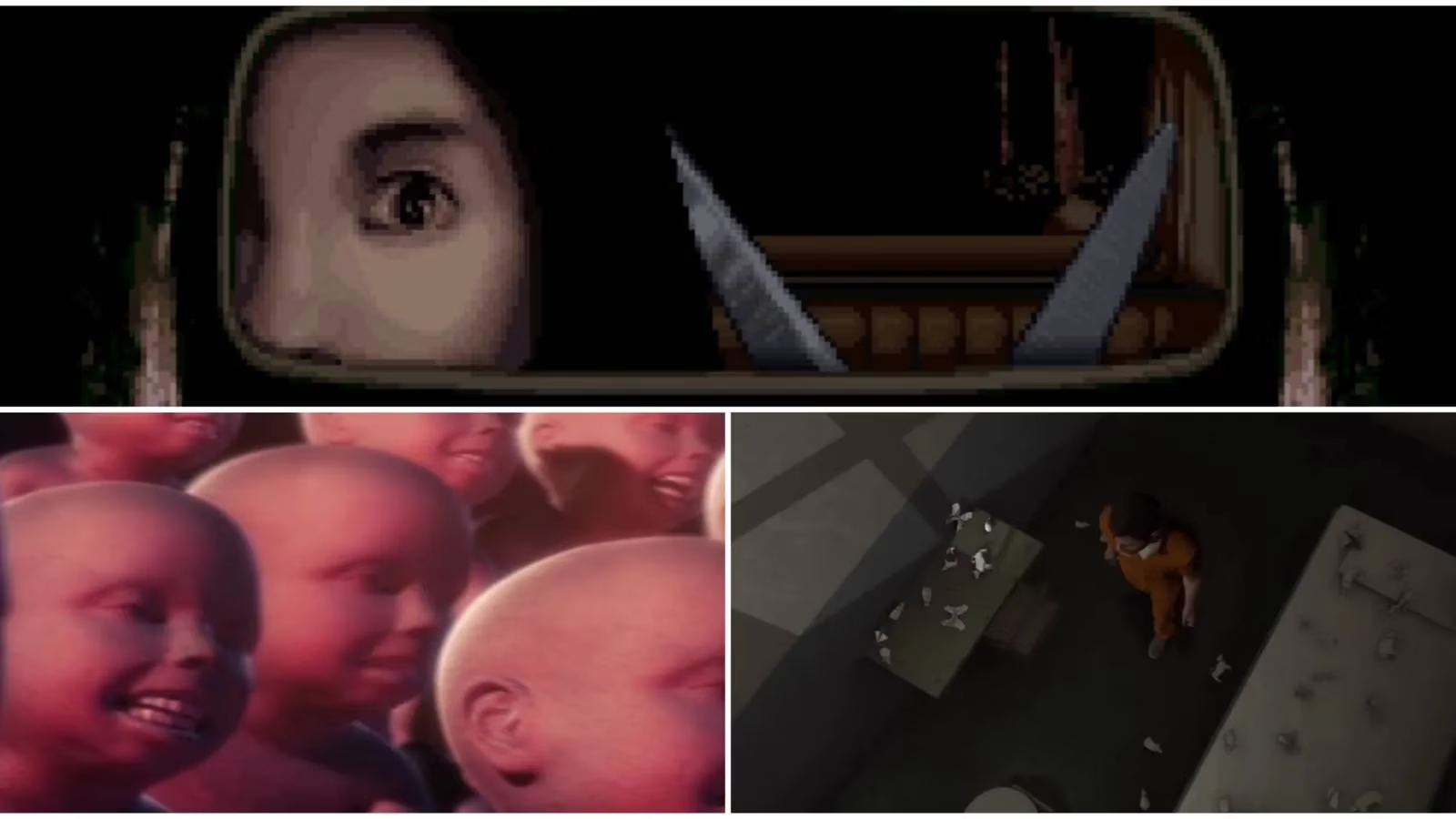
Horror games, of course, are fertile ground for these endings. The classic Clock Tower on Super Famicom offered a smorgasbord of dreadful outcomes. Most players guide Jennifer to escape the scissor-wielding maniac. But the game allowed for a darker selfishness. You could find the car keys and simply leave your friends behind. The consequence? It wasn't freedom. If you abandoned both friends, Jennifer would be found dead at the orphanage. If you left while one was still alive... well, let's just say the Scissorman appreciated the carpool. This wasn't a game punishing you for losing; it was punishing you for choosing to survive at the expense of others, a theme that would echo for years.
Time manipulation stories often deal with heavy consequences, but Singularity presented a particularly nihilistic trio of choices. As Captain Renko, messing with time created a tyrant named Demichev. The "good" ending had you kill Demichev and fix the timeline. The "bad" ending had you kill your ally Barisov and rule alongside the tyrant. But the secret third option? Kill them both. Not to save the world, but to let it crumble into ruin, with yourself as its sole, time-bending master. It's the ultimate corruption of power, a ending where the hero doesn't just fail—he actively chooses to become the ultimate problem, a god-king of ashes.
Even fighting games, not known for nuanced storytelling, have dabbled in this. Tekken 5's final boss, Jinpachi Mishima, was an unplayable monster. But if you lost to him and let the continue timer run out, you'd see his secret ending. Without a warrior strong enough to defeat him, his demonic possession completes. He fully transforms, and the screen simply tells us "the world will never be the same." It's an ending of pure, unchecked escalation, a failure so complete it rewrites the future of the entire game's universe in the worst way possible.
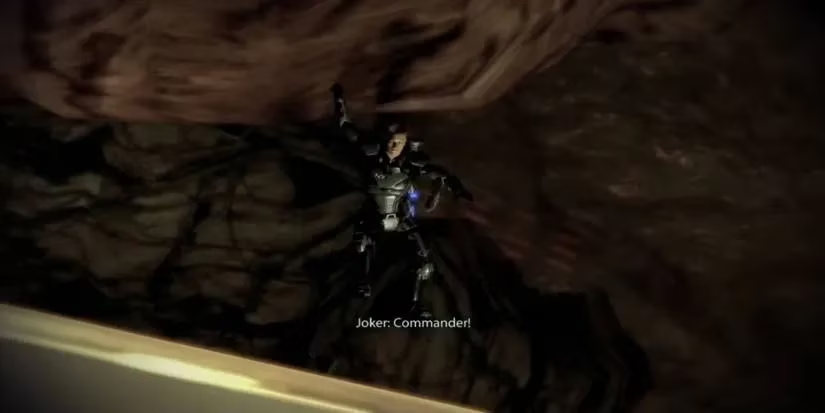
Speaking of universes, few games made me care about a crew like Mass Effect 2. That final suicide mission is legendary. Get it right, and everyone lives—a triumph against impossible odds. Get it wrong, and the body count is staggering. But the darkest, most secret outcome? The one where every choice is wrong. I had to try it once, just to see. One by one, my squadmates fell: Garrus, Tali, Mordin... all gone. The Normandy's interior, once bustling with life, became a ghost ship. In the worst scenario, even Shepard doesn't make it, dying just short of the airlock, leaving only Joker alive to tell the tale of the galaxy's greatest failure. It's a masterclass in making victory feel earned by showing you just how catastrophic failure can be.
The line between man and monster blurred completely in The Suffering. Torque's journey through Carnate Island's hellish prison was a fight against external and internal demons. The game presented multiple endings based on your actions, revealing the truth of Torque's past crime. The 'bad' ending wasn't just about losing; it was about embracing the beast within. It reveals that Torque didn't just kill his family—he did so deliberately, in a fit of rage. In this ending, he doesn't overcome his demon; he becomes it, fully transforming into one of the horrific creatures he's been fighting, completing his descent. It's a ending about the loss of humanity, not to an external force, but from within.
David Cage's Heavy Rain may have its dated moments, but its capacity for sheer despair remains potent. Among its many endings, the "Helpless" ending stands as a monument to player-driven tragedy. To achieve it, you must fail at almost every turn: get Ethan arrested, fail to find the crucial clues, lose Madison, lose Norman, and finally, see your last son die. Framed for the Origami Killer's murders, utterly broken and alone in his cell, surrounded by the killer's paper cranes, Ethan makes his final choice. He hangs himself. It's an ending devoid of any catharsis or meaning, just the cold, quiet end of a man who has lost everything, including hope.
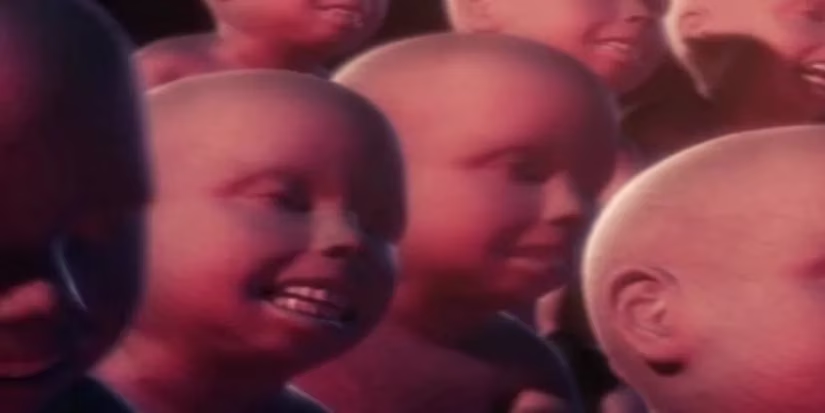
And then there's Drakengard, a game that seems to despise the very idea of a happy ending. While Endings A through C range from bittersweet to apocalyptic, the real secrets are Endings D and E. Ending D, unlocked by completing all chapters, presents a Lovecraftian horror: the world is overrun by the grotesque Queen Beast and her children. But Ending E... Ending E is something else. It requires a 100% completionist's grind—every weapon, every chapter. Your reward? The final battle is teleported to modern-day Tokyo, transforming into a brutal, rhythm-game-style sequence against the Queen Beast. Succeed, and you're not treated to a victory cutscene. You're met with a stark, silent screen that essentially conveys the developers' contempt for your completionist efforts. It's a meta-nightmare, an ending that attacks the player for engaging with the game too deeply.
Of course, no discussion in the modern era is complete without Undertale. The Genocide route is an open secret now, but discovering it for the first time was a uniquely harrowing experience. It's not an ending you stumble into; you must consciously, meticulously choose it. You linger in every area, grinding random encounters until the message "But nobody came" appears. You hunt down and kill every named character. The world empties. The music distorts. Characters like Undyne and Sans fight with a desperate, tragic fury you never see otherwise. And when you finally "win," you don't get a crown. You meet Chara. The true horror isn't the fight—it's the consequence. Chara doesn't just kill your character; they corrupt your save file, tainting any future attempts at a happy ending with their presence. "You want to go back to the world you destroyed?" It's a punishment that transcends the game itself, making you, the player, complicit in a way few other games dare.
Looking back from 2026, these secret endings represent more than just Easter eggs or bonus content. They are the shadow selves of their games' narratives. They explore failure, cowardice, nihilism, and corruption not as game over screens, but as legitimate, player-directed conclusions. They ask uncomfortable questions: What if the hero gives up? What if the power corrupts absolutely? What if the monster was inside us all along? Chasing these endings has been a dark, fascinating pilgrimage. They remind me that in gaming, as in life, the easiest path isn't always the right one, and the hardest truths are often the ones we have to seek out for ourselves. They are the stories we weren't supposed to see, and that's precisely why they are the ones I can never forget.
0 Comments