The Most Innovative Boss Fights in Gaming History That Still Amaze Players Today
Memorable boss fights and innovative video game battles redefine gaming, offering legendary encounters that shape game design and player experience.
I've been playing video games for as long as I can remember, and one thing that always sticks with me long after the credits roll are those truly memorable boss fights. You know the ones—they're not just about whittling down a giant health bar with the same three attacks. They're the encounters that completely change the rules, surprise you with their creativity, and make you feel like you're experiencing something genuinely new. Over the decades, some developers have created battles so innovative they've become legendary, shaping how we think about game design itself. Let me walk you through some of my absolute favorites, the fights that prove boss battles can be so much more than just a test of reflexes.
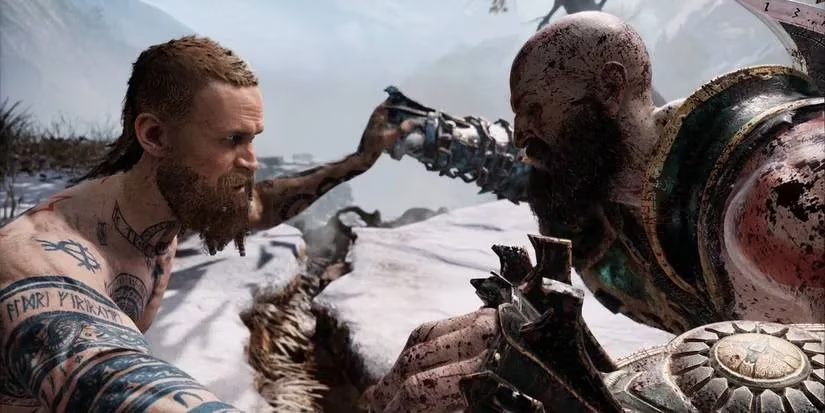
Let's start with a modern masterpiece. The first time I faced The Stranger in 2018's God of War, I was completely floored. Here I was, barely an hour into Kratos's new journey in Midgard, still processing his wife's funeral, when this mysterious, powerful being shows up at my doorstep. The fight isn't just a battle—it's a cinematic experience woven directly into the narrative. It seamlessly blends brutal combat with quick-time events and story beats, all while introducing the Spartan Rage mechanic. What makes it so brilliant is how it establishes the stakes. This stranger knows Kratos's true identity as a god, hinting at the larger conflict to come. It's a fight that serves the story perfectly, making you invested in the journey right from the start.
Sometimes innovation comes from pure spectacle. I'll never forget facing Bob Barbas in DmC: Devil May Cry (2013). Yes, the reboot was divisive, but this fight? Absolutely unforgettable. You're battling a demonic, sensationalist news reporter, and the game completely shifts perspective to chopper camera angles, pulling you across earlier game areas. The true visual terror comes from Barbas's final form—a haunting, giant head composed of hundreds of flickering television screens. It's not the hardest fight mechanically, but it's compelling commentary wrapped in a visually stunning, reality-bending spectacle.
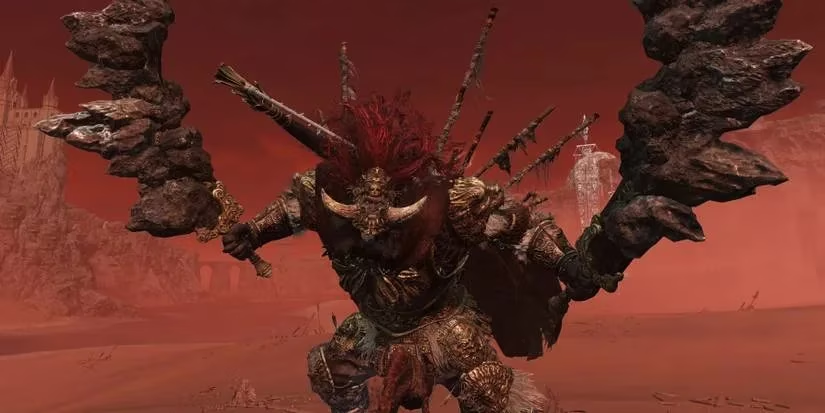
Now, when we talk about epic scale, few can match the sheer grandeur of Starscourge Radahn in Elden Ring. FromSoftware has always been the master of challenging bosses, but this 2022 encounter is something special. You're summoned to a vast, red desert field for a festival of war. The real twist? You can call upon a small army of NPC allies to ride into battle with you against this fallen demigod. The arena is massive, allowing for horseback combat and numerous strategic approaches. Radahn himself is a force of nature, unleashing meteor showers and gravitational magic. It feels less like a boss fight and more like participating in a mythic, world-altering event.
For pure, unadulterated creativity, you have to look at The Simpsons Game (2007). Its final boss battle is arguably one of the most unique in history. The Simpsons family faces God Himself... in a Dance Dance Revolution-inspired rhythm battle. As divine mobs descend vertical rows, you frantically tap arrow keys to protect the family. It's absurd, self-referential, surprisingly challenging, and packed with the series' signature humor. It proves that innovation doesn't always have to be serious—it can be wildly fun and completely unexpected.
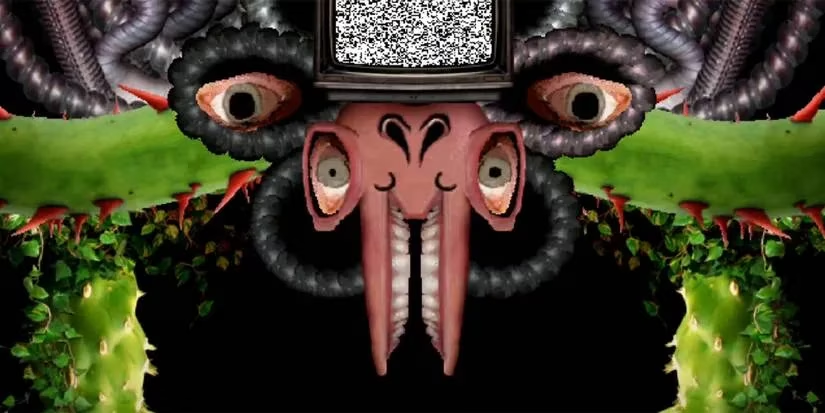
Then there are fights that break the game itself. The Omega Flowey encounter in Undertale (2015) is a masterpiece of meta-commentary and psychological horror. This isn't just a battle; it's an assault on the player. Flowey corrupts the game's save files, talks directly to you (not the character), and constantly shifts the rules. The screen glitches, the mechanics change, and the familiar combat UI becomes a weapon against you. It's a exhausting, brilliant culmination of the game's themes about choice, consequence, and player agency. Few bosses have made me feel so personally targeted and immersed.
Sometimes, the most innovative solution is no violence at all. The original Fallout (1997) pioneered this with The Master. With high Speech and Intelligence stats (or Vree's autopsy report), you could convince the game's final villain to self-destruct through dialogue alone. In 1997, this was revolutionary. RPGs were about combat, but here was a legitimate, rewarding pacifist path that required character building, not bullet sponging. It changed how we think about conflict resolution in games.
The Metal Gear Solid series is a treasure trove of innovative design, but two fights stand out. First, The End in MGS3: Snake Eater. This isn't a boss battle; it's a three-day-long sniper duel across a massive jungle. The End, a 100-year-old legendary marksman, uses camouflage and patience. You must track him using sunlight glints off his scope or subtle environmental clues. You can even wait him out by changing your console's clock! It redefined stealth and patience in boss design.
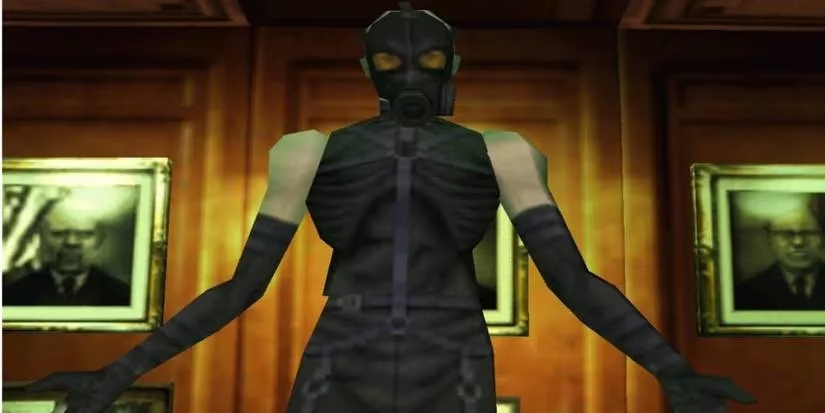
Then there's Psycho Mantis from the original Metal Gear Solid (1998). This fight broke the fourth wall in ways that shocked players. Mantis would read your memory card data, commenting on other games you'd played. He'd "predict" your moves by reading controller inputs. The solution? Physically switching your controller to the second port on the PlayStation. It was a mind-blowing moment that made the game world feel real in a way nothing had before.
Finally, let's talk about Mr. Freeze in Batman: Arkham City (2011). This fight is a brilliant puzzle. Freeze adapts. Every time you hit him with a specific takedown method—a silent takedown, a vantage point attack, a explosive gel blast—he becomes immune to it. You're forced to use every tool in Batman's arsenal, from the Batclaw to the Remote Electrical Charge. It's a dynamic test of mastery that makes you feel like the World's Greatest Detective, not just a brawler.
Looking back at these fights in 2026, their influence is undeniable. They taught us that boss battles could be:
-
Narrative engines (God of War's Stranger)
-
Spectacles (DmC's Bob Barbas)
-
Epic events (Elden Ring's Radahn)
-
Meta-commentaries (Undertale's Flowey)
-
Puzzles (Arkham City's Mr. Freeze)
-
Dialogues (Fallout's The Master)
-
Stealth challenges (MGS3's The End)
-
Fourth-wall breaks (MGS's Psycho Mantis)
These innovations didn't just make individual games better; they expanded the entire language of game design. They proved that a boss fight could be anything—a conversation, a rhythm game, a sniper duel, or a psychological horror show. They asked players to think differently, to engage with mechanics in new ways, and to feel something beyond just triumph. That's their true legacy. Even now, when I face a new boss, I find myself hoping for that spark of creativity, that moment where the game surprises me and becomes something I'll remember for years to come. Because that's what the best boss fights do—they don't just end a level; they define an experience.
0 Comments