The Ultimate Test: Video Games Where Hard Mode is the True Experience
In 2026, **hard mode** and **game difficulty** remain the ultimate benchmarks for immersive, rewarding gameplay. Titles like Devil May Cry and Metal Gear Rising transform challenge into a masterclass of mechanics, demanding flawless execution and deep mastery. These experiences prove the most rewarding journeys lie on the path of greatest resistance.
In the ever-evolving landscape of video games, difficulty settings have long been a standard feature, offering a spectrum of experiences from casual relaxation to punishing challenge. While many games simply tweak enemy health and damage output, a select few treat their hardest modes not as mere afterthoughts, but as the definitive way to experience their worlds. These titles weave challenge into the very fabric of their design, transforming hard mode from a test of endurance into a masterclass in game mechanics and immersive storytelling. For the dedicated player in 2026, these experiences remain benchmarks, proving that the most rewarding journeys often lie on the path of greatest resistance.
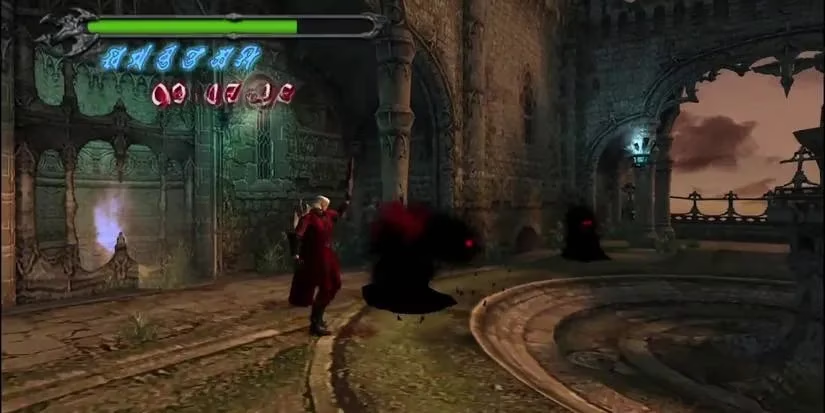
Devil May Cry: A Symphony of Stylish Carnage
To be fair, this entry could count most hack and slashers, as they often alter enemy layouts. But Devil May Cry was the genre's pioneer in this regard. Each difficulty setting morphs the experience into an almost entirely different game, with more formidable foes appearing earlier and new adversaries like Shadows and Frosts emerging to test players' mettle. The series is renowned for its gimmick modes that are less about sadism and more about forcing mastery. DMC4's Legendary Dark Knight Mode swarms the screen with enemies in numbers reminiscent of Dynasty Warriors, turning every encounter into a chaotic ballet of blades. Meanwhile, modes like Heaven & Hell (where every entity falls in one hit) and Hell & Hell (where only the player is fragile) demand precision and flawless execution. These challenges act like a master swordsmith's hammer, forging players who must utilize every nuance of the character's move list to survive. The hard modes here are not a barrier but a gateway to achieving a state of flow as graceful and intricate as a Swiss watch's mechanism.
Metal Gear Rising: Revengeance - The Parry Paradigm
While the core Metal Gear stealth titles demand perfection on their hardest settings, Metal Gear Rising: Revengeance stands apart as a character action game that lives and dies by its parry mechanic. The entire difficulty curve is a testament to how well a player gels with this system, which, while not overly complex, is notoriously under-explained. Once mastered, the game's perspective shifts dramatically: Hard feels standard, Normal becomes trivial, and Easy practically plays itself. The true trial is Revengeance Mode, a crucible that demands frame-perfect parry counter-attacks to deal meaningful damage. Playing on lower difficulties is like navigating with training wheels; Revengeance Mode removes them, the stabilizers, and even the handlebars, demanding the player become one with the blade. It transforms Raiden's high-speed combat into a deadly, rhythmic dance where every enemy attack is an invitation for a devastating riposte.
Thief: The Dark Project - The Art of the Perfect Heist
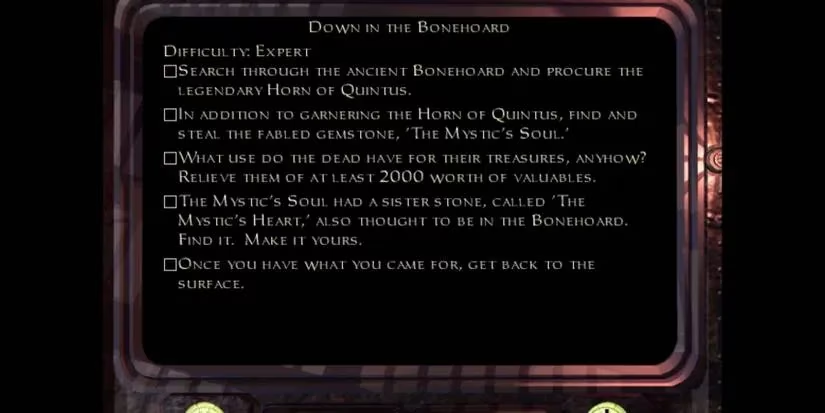
For stealth purists, Thief: The Dark Project redefined challenge through objective-based difficulty scaling. On easier settings, master thief Garrett might simply need to steal a scepter. But on the harder difficulties, the missions blossom with layered complexity, adding demands for extra loot, stricter time limits, and a steadfast "no kills" policy. This design philosophy elevates the challenge from mere avoidance to a high-stakes puzzle. Succeeding on these harder settings is akin to performing a flawless heist in a museum guarded by laser grids and motion sensors—it requires planning, patience, and impeccable execution. The reward is not just completion, but the profound satisfaction of having outwitted an entire world designed to catch you, honing your skills into those of a ghost in the machine.
Alien: Isolation - The Developer's Intended Horror
In a rare move, the developers of Alien: Isolation have historically recommended starting the game on its Hard mode. This wasn't an arbitrary choice; Hard was their baseline, the experience meticulously crafted to deliver the relentless tension of the original film. On easier settings, the Xenomorph's appearances are reduced, diluting the terror. On Hard, it becomes a persistent, learning predator that adapts to the player's habits—checking lockers if they're overused. Combined with severe item scarcity, Hard mode strips away comfort and plunges players into a survival scenario as desperate and claustrophobic as being adrift in a lifeboat on a pitch-black ocean. For those who crave absolute desolation, Nightmare mode goes further, removing helpful HUD elements and amplifying the creature's intelligence, offering a purity of horror that lesser difficulties simply cannot match.
The Last of Us - Brutal Realism
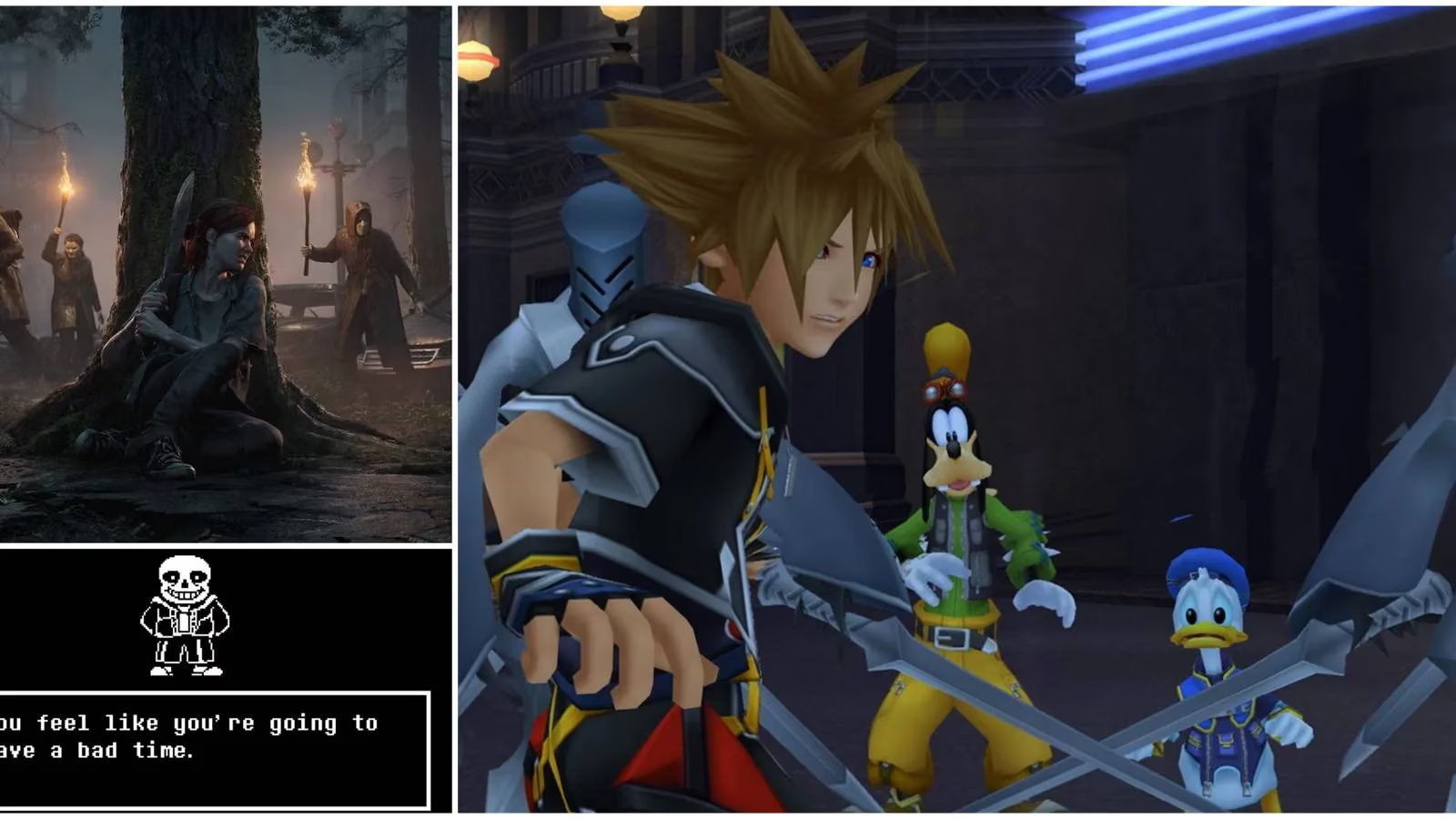
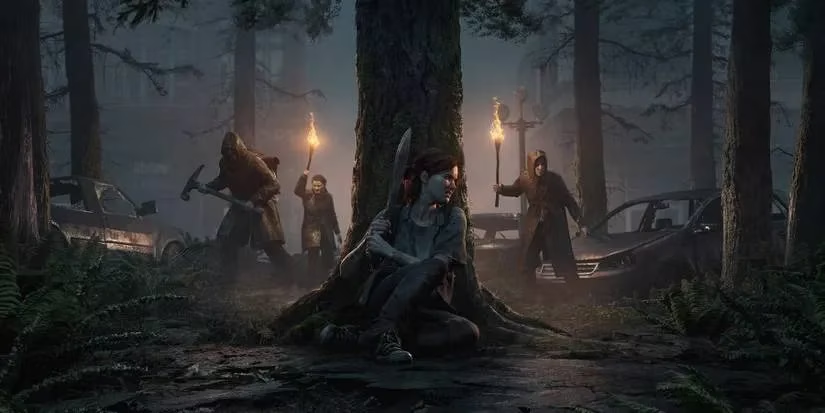
Naughty Dog's post-apocalyptic masterpiece, The Last of Us, derives its power from immersion and emotional weight. This impact is profoundly amplified on its harder difficulties. While easier settings offer more resources and forgiving enemies, Hard mode meticulously recreates the desperate scarcity of its world. Every bullet, every medkit, becomes a precious commodity. A single mistake can lead to a cascade of failures, forcing players to agonize over every engagement. This transforms the gameplay from a series of combat encounters into a tense, strategic struggle for survival that mirrors Joel and Ellie's fraught journey. Playing on Hard is like walking a frayed tightrope over a chasm—the margin for error is vanishingly small, making every successful step a monumental relief and every misstep a devastating plunge.
The Evil Within - Survival Over Slaughter
Directed by survival horror legend Shinji Mikami, The Evil Within presents two distinct experiences based on difficulty. On Normal, players can often resort to aggressive tactics. However, the harder difficulties fundamentally change the game's DNA, forcing a shift to cautious, observant stealth. Resources are critically scarce, and enemies are lethal. This forces players to study monster patrol patterns, listen for audio cues, and choose their moments with precision. In this context, Hard mode embodies true survival horror, where the horror stems from vulnerability and resource management. The easier modes, by contrast, feel more like action-horror excursions. The difference is as stark as that between navigating a minefield in the dark versus walking through a haunted house—one requires silent, life-or-death calculation, while the other offers managed thrills.
Resident Evil 7: Biohazard - A Fresh Nightmare
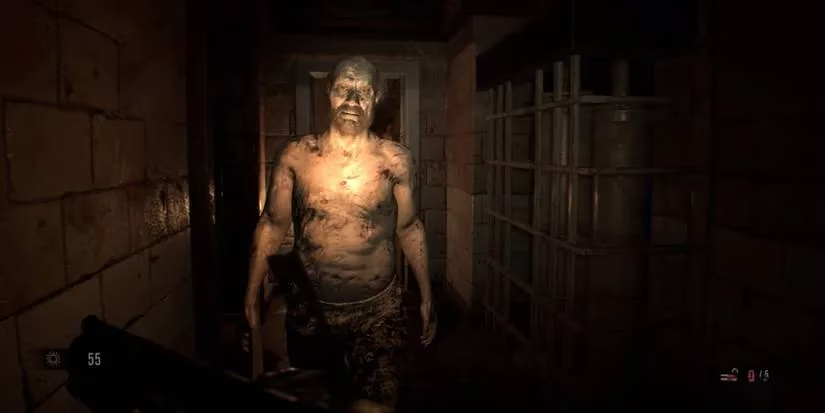
Resident Evil 7 marked a return to the series' horror roots, and its Madhouse difficulty is a love letter to veteran fans. This isn't just a stat increase; it's a full-game remix. The deranged Baker family becomes even more resilient, enemy and item placements are shuffled into new, unfamiliar configurations, and saves are limited to a few consumable cassette tapes. This design ensures that even players who have memorized the Normal mode are confronted with fresh puzzles and renewed terror. Madhouse mode acts like a funhouse mirror, distorting a familiar space into something new and threatening, ensuring the experience remains potent and unpredictable.
Undertale - Morality as Difficulty
Toby Fox's indie phenomenon Undertale forgoes traditional difficulty settings, instead baking its ultimate challenges into its moral playthroughs. The Pacifist route, requiring players to spare every enemy through non-violent means, transforms battles into intricate bullet-hell puzzles. The Genocide route, demanding the extermination of every creature, unlocks brutally difficult boss fights against characters like Undyne the Undying and Sans. These are not mere gameplay challenges; they are narrative and mechanical culminations of the player's choices. Mastering these routes is like solving an ethical Rubik's Cube where every turn has profound consequences, offering vastly different and deeply challenging endings that define the experience.
Kingdom Hearts II: Final Mix - Critical Calculus
The whimsical world of Kingdom Hearts hides one of gaming's most brilliantly balanced hard modes: Critical Mode. Introduced in Kingdom Hearts II Final Mix, it redefines the risk-reward equation. Players operate with half their usual HP and take double damage, a change that would seem punitive. However, they also deal increased damage, gain abilities earlier, and earn AP faster. This creates a razor's edge dynamic where combat is lethally swift for both sides. Critical Mode demands perfect understanding of enemy patterns and the game's deep mechanics, rewarding mastery with faster, more spectacular victories. It's a mode that treats the player not as a child to be coddled, but as a Keyblade master in training, offering a challenging yet fair path to power that has kept fans engaged for decades.

Conclusion: The Philosophy of Challenge
As games continue to advance in 2026, the philosophy behind meaningful difficulty design remains crucial. The best hard modes do not simply inflate numbers; they recontextualize the game, unveiling deeper layers of strategy, narrative tension, and mechanical depth. They respect the player's intelligence and dedication, offering a distinct, often superior, version of the experience. From the adaptive terror of Alien: Isolation to the rhythmic precision of Metal Gear Rising, these games prove that when challenge is woven into the core design, the hardest path can also be the most rewarding and memorable.
0 Comments