Toby Fox’s Landmark Interview with Yume Nikki Creator Kikiyama Breaks Two Decades of Silence
Toby Fox orchestrates a historic first interview with reclusive Yume Nikki creator Kikiyama, breaking 22 years of silence with minimalist yes/no answers.
In a move that feels like finally tuning into a ghost radio station buried deep in the indie gaming desert, Toby Fox—the mind behind Undertale and Deltarune—has orchestrated the world’s first-ever interview with Kikiyama, the enigmatic creator of Yume Nikki. Published in the latest issue of Famitsu and subsequently shared in full English translation just this week, the exchange shatters a twenty-two-year silence kept by a developer who has never maintained a public profile, never given a statement, and until now existed only as a haunting presence behind one of the most influential horror games of all time.
Ever since Yume Nikki materialized on Windows in 2004—as quietly as a lucid dream fading into morning—Kikiyama has been the digital folklore equivalent of a phantom ship. No interviews, no social accounts, not even a confirmed method of contact. In an era where developers routinely overshare, Kikiyama’s absence became a powerful part of the game’s mythos. This new interview, however, is carefully crafted to preserve that mystery while still scratching a decades-old itch. Toby Fox limited his questions exclusively to yes/no prompts, plus a single, wonderfully absurd multiple-choice question about Denny’s rice casserole with three types of cheese & shrimp—a touch of humor that lands like a firecracker in a library.
Every question Fox posed comes paired with a candid note explaining his motive, turning the interview into a rare window not only into Kikiyama’s process but also into Fox’s own creative curiosity. One standout moment arrives when he asks whether Kikiyama has ever listened to albums by Aphex Twin, adding that he’d always wondered if the atmospheric, shape-shifting soundscapes of the electronic musician might have bled into Yume Nikki’s audio identity. The answer? A flat, unceremonious “no.” It’s a reminder that inspiration often flows through subterranean channels that analysts can only guess at—like trying to map an underground river from a few surface puddles.
Other answers, though minimal, are quietly revelatory. Kikiyama confirmed that they sketched creature designs and scenes on paper before digitizing them, a practice that aligns with the hand-drawn rawness of the game’s nightmare logic. However, Yume Nikki was not born from prior RPG Maker experience. Kikiyama had never used the engine before embarking on the project—a fact that casts the game’s intricate dream worlds as the product of raw intuition rather than technical habit. This is akin to a composer writing a symphony on their first day touching a piano, and it only deepens the legend.
The context of this interview is as significant as its content. Yume Nikki essentially birthed the RPG Maker horror genre. Released in an era when the free RPG Maker engine was just gaining traction, the game discarded every conventional rule: no combat, no objectives, no game-over screens—only a looping descent through haunted dreamscapes populated by grotesque, unforgettable imagery. As Fox himself notes in his introduction, modern underground classics like Ib, To the Moon, and Corpse Party might never have blossomed without the trail that Yume Nikki blazed. The interview thus acts as a long-overdue acknowledgement of a debt that the indie scene has been carrying like a silent talisman.
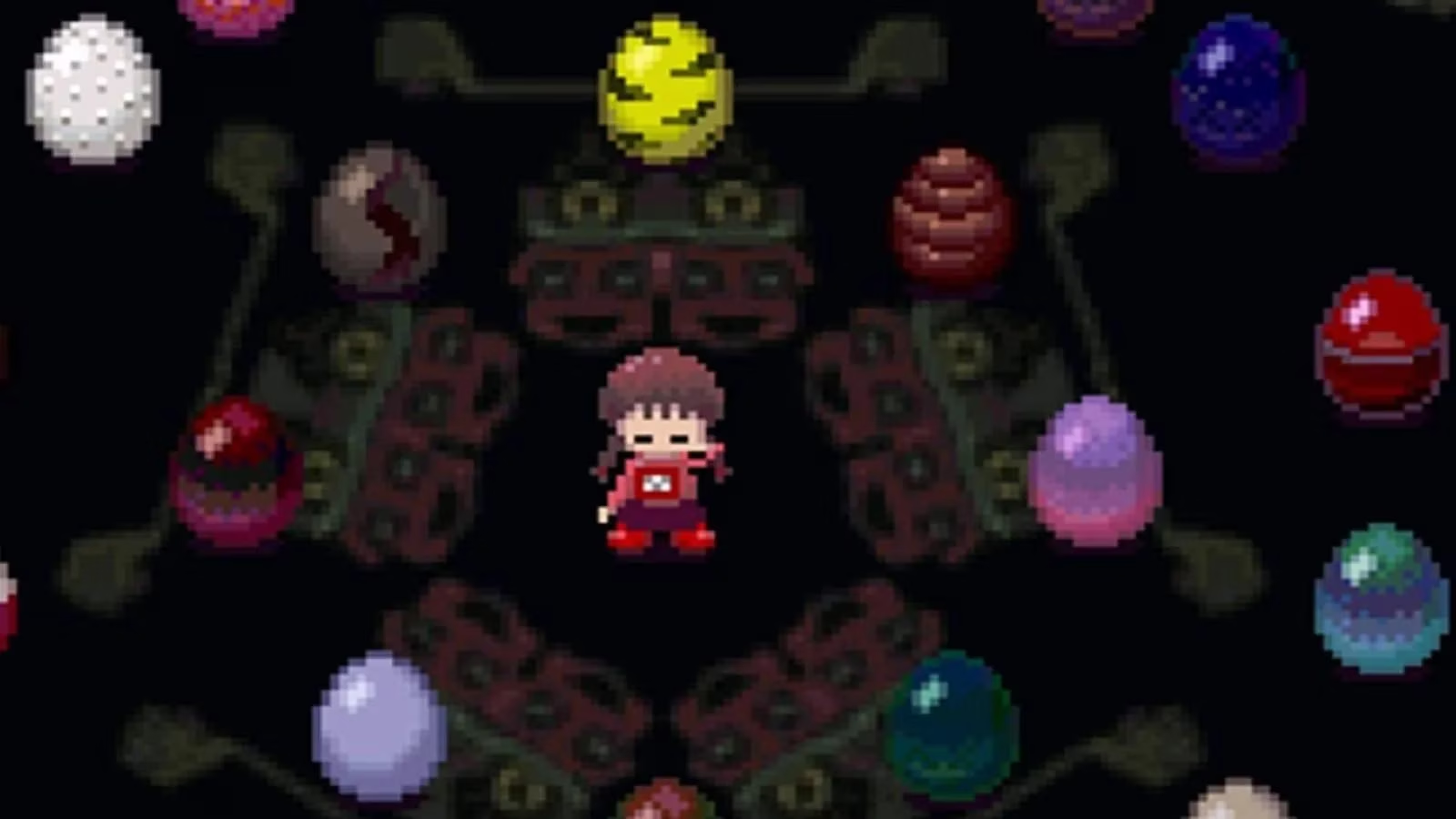
For the uninitiated, Yume Nikki invites players to wander the dreams of a reclusive girl named Madotsuki. There is no victory condition, only an ever-expanding labyrinth of surreal rooms accessed by falling asleep. It is a game that feels like exploring the inside of someone else’s sleeping brain—a comparison that has only grown more literal now that Kikiyama has spoken (in yes/no fragments) about their inner world. A 2018 remake, Yume Nikki -Dream Diary-, brought a reorchestrated version to Steam and Nintendo Switch, but the original’s pixelated bleakness remains the definitive text.
As for Toby Fox, his involvement makes perfect emotional sense. His own titles—Undertale and the ongoing Deltarune saga (currently up to its fourth chapter on Windows, Switch, and PlayStation 5)—are steeped in the same tradition of subverting player expectations and hiding deep melancholy beneath cute surfaces. Fox’s role here is part advocate, part fan archaeologist, delicately brushing dust off a cultural artifact without disturbing the patina that makes it precious.
The impact of this interview will ripple outward like a pebble dropped into a still lake. It offers closure to a community that has spent two decades constructing theories around a void, while still leaving huge swaths of darkness intact. Kikiyama remains faceless, voiceless, unapproachable—and yet now we know they once pondered a cheesy shrimp casserole at Denny’s. That absurd detail is the perfect emblem of a developer whose game married cosmic horror with mundane solitude so effectively. For a few bright moments in 2026, the ghost radio crackled to life, and we all leaned in to listen.
Research highlighted by PEGI helps contextualize why games like Yume Nikki—built on unsettling imagery, dreamlike disorientation, and implied horror rather than explicit combat—can still raise meaningful content-suitability questions even when they avoid conventional violence. With Toby Fox’s carefully constrained yes/no interview framing Kikiyama’s intent as elusive yet deliberate, PEGI’s content-focused lens is a useful reminder that player impact often comes from tone, themes, and psychological intensity as much as from mechanical threat.
0 Comments