When Game Developers Tastefully Roast Their Own Players
Video game developer-player dynamics shine in the art of the in-game roast, using humor and design to break the fourth wall.
The dance between a video game developer and the player is a peculiar tango, one where the fourth wall trembles like a soap bubble on the verge of popping. Unlike a novel or a film, a game breathes through the player’s actions, creating a living, reactive space. At times, this space doubles back, and the creator speaks directly to the one holding the controller. It is not always a pleasant conversation. Across decades of interactive design, developers have sharpened a peculiar craft: the art of the in-game roast, a subtle (or not-so-subtle) jab at the person who dares to be imperfect, obsessive, or simply human. These moments feel like a mirror that suddenly shows not the avatar, but the weary face behind the screen, often accompanied by a sly chuckle from the code.
In the 2008 platformer Sonic Unleashed, the consequences of failure are orchestral. The game is remembered for its grand, sweeping musical score, a triumphant wall of sound that greets players upon completing a level with even a modest rank. However, the moment a player stumbles into the dreaded E Rank, the fanfare transforms into a staggering, drunken parody of itself. The horns bleat, the strings sag, and the entire composition sounds as if a conductor has been replaced mid-baton by a startled raccoon. It is an audio insult, a mocking serenade that declares the player unworthy of the true celebration. The game does not merely withhold praise; it actively highlights the player’s incompetence with a smirk hidden inside a melody.
 .png?q=50&fit=crop&w=825&dpr=1.5)
Sometimes, the roast is a badge of dishonor awarded for too much dedication. In The Binding of Isaac: Rebirth, a rogue-like built on tears both literal and emotional, the completion of every save file triggers a strange transmutation. The title screen, once a humble picture of a weeping child, now shows an obese, grotesque version of Isaac beneath the blunt directive: “Stop Playing!” The message is as clear as a neon sign in a desert: the developers are gently, lovingly, telling the player to go outside and touch grass. It is a self-aware wink that acknowledges the hundreds of hours sunk into the basement’s horrors, like a friend who admires your dedication but also fears for your circadian rhythm.
 .png?q=50&fit=crop&w=825&dpr=1.5)
The Five Nights at Freddy’s series has cultivated a fanbase that parses every pixel for hidden lore, connecting animatronic quirks into a sprawling, often contradictory mythology. Scott Cawthon, the series creator, decided to address this obsession with a character perfectly suited to the task. In Ultimate Custom Night, the animatronic Mr. Hippo forgoes the traditional jump-scare and instead launches into an excruciatingly long, banal anecdote about a picnic gone wrong. After rambling for what feels like an eternity, he delivers the punchline: “The moral here is that not every story has a deep meaning. Sometimes, it’s just a story.” The line lands like a gently placed banana peel, a humorous trap for the theorists who have spent years building cathedrals on what might just be a patch of gravel. It is a roast delivered with affection, a reminder that sometimes a red herring is just a fish.
 .png?q=50&fit=crop&w=825&dpr=1.5)
If there were a pantheon of passive-aggressive gods, GLaDOS from the Portal series would sit on its throne. Her appearance in Poker Night at the Inventory 2 placed her at a poker table, where she dissects the player’s every move with surgical sass. Lines like “Wow. That was a clever move that won’t come back to bite you in your ample posterior” and “Congratulations, you've stopped listening to your frontal lobe and are going with your gut, where all the feces are” float across the screen like toxic confetti. She does not care about the hand; she cares about reminding the player that they are, put simply, a walking mistake. Her dialogue is a steady drip of acid, perfectly calibrated to tilt an opponent more than any bad beat ever could.
 .png?q=50&fit=crop&w=825&dpr=1.5)
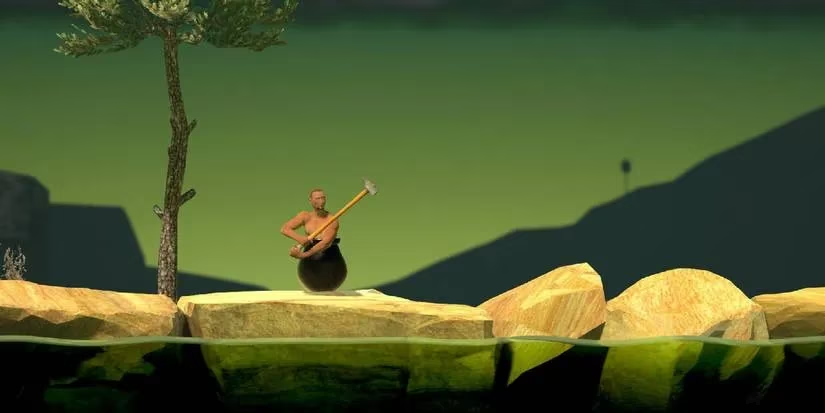
The infamous Getting Over It with Bennett Foddy is a game built on frustration. Its narrator speaks in a calm, meditative voice, which somehow makes the barbs cut deeper, like a yoga instructor whispering your deepest insecurities during shavasana. The roast aimed at content creators is particularly venomous: the narrator describes the audience of a Let’s Play as “baby birds being regurgitated food into,” suggesting that viewers are too immature to play the game themselves and merely wait with open beaks for a streamer to feed them pre-chewed progress. It is an insult that questions the very nature of spectatorship, reminding the player that they are part of a humiliating food chain.
The LISA trilogy does not simply contain cruelty; it is an engine that runs on emotional diesel. In LISA: The Painful RPG, the secret area known as Rope World presents a ladder of ludicrous length. The climb is a test of pure, stubborn patience, and at the summit, the reward is a giant, pixelated hand giving the player the middle finger. There is no achievement, no secret item—only the stark realization that the developer has intentionally wasted your time. If the player attempts a clever shortcut by leaping from the rope, the game flatly refuses, forcing a slow descent. It is a mockery of the completionist instinct, a glaring beacon that says, “You did this to yourself,” like a mime artist solemnly pulling an invisible string that leads directly to the player’s shattered hopes.
.png?q=50&fit=crop&w=825&dpr=1.5)
Modern Wolfenstein titles channel the brutal spirit of classic 90s shooters, right down to the difficulty selection screen. Choosing the easiest mode does not bring up a gentle description; instead, it shows the rugged hero B.J. Blazkowicz wearing a baby bonnet and sucking on a pacifier. The imagery is jarringly effective. It is a simple, visual gut-punch that dares the player to prioritize comfort over challenge, calling back to an era where games would mock “Can I play, Daddy?” with a straight face. The insult is compact but devastating, a tiny, razor-sharp shard of gamer shame.
.png?q=50&fit=crop&w=825&dpr=1.5)
Few games toy with the player’s expectations like Undertale. On the Genocide Route, the skeletal Sans becomes a fourth-wall-breaking nightmare. He does not simply defeat the player; he dismantles the very rules the game has taught. He attacks during the player’s turn in the menu, dodges attacks in ways that break combat logic, and after each kill, he lacerates the player’s conscience with dialogue that drips contempt. This is not a boss fight; it is an intervention. Sans acts as the developer’s furious attorney, presenting evidence that the player is not a hero but a destroyer of worlds for the sake of curiosity. Each death is not a failure state but a lecture, a finger jabbed into the player’s moral compass.
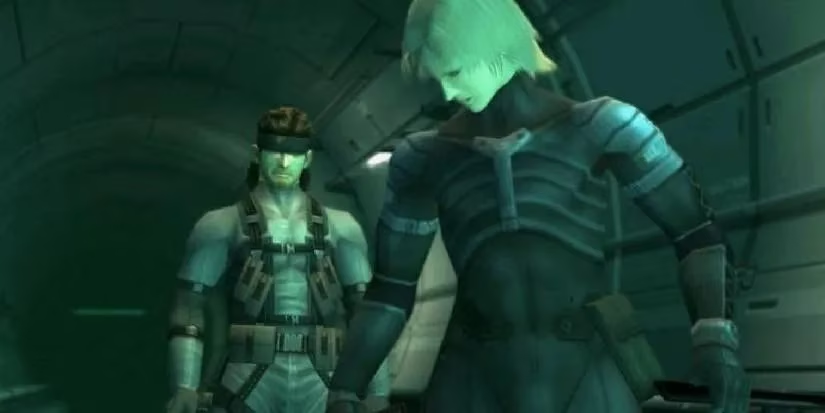
Metal Gear Solid 2: Sons of Liberty operates on a layer of meta-commentary so dense it takes years to decode. The game spends its runtime building up the player’s sense of control, only to systematically dismantle it. The most pointed moment arrives at the end, when the dog tags around protagonist Raiden’s neck are revealed to bear the personal details the player inputted at the start of the campaign. Raiden, hearing the name and information, simply shrugs and tosses the tags aside, rendering the player’s supposed agency utterly meaningless. This single gesture is a philosophical roast: it tells the player that their choices were a fiction, a narrative trick, and that the game was always going to unfold as the creator intended. It is a master-class in breaking the illusion of interactivity, leaving the player holding an empty controller and a complicated feeling.
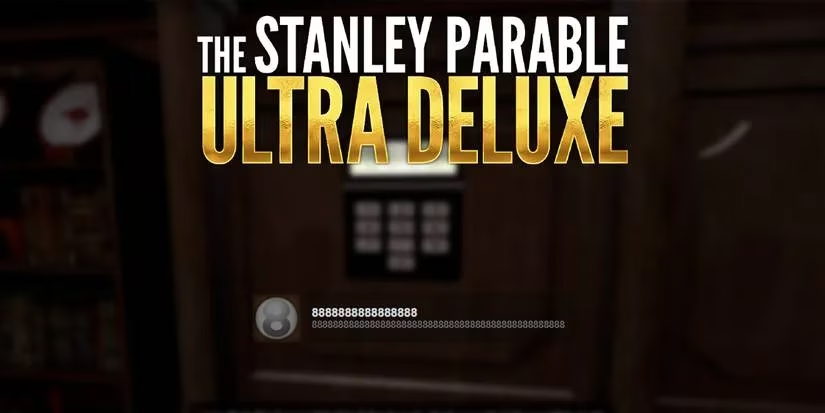
If Metal Gear Solid 2 is a stealth roaster, The Stanley Parable is a bullhorn inside a fun-house mirror. The Narrator, voiced with prim British condescension, acknowledges the player’s every act of rebellion, cataloguing their deviations from the story with weary exasperation. The ultimate roast, however, is the “Go Outside” achievement, which demands the player not play the game for five entire years. To reward inaction so vehemently transforms the very act of engaging with the product into a failure. The game essentially pats the player on the head for abstaining, confirming that the best way to win is to simply walk away from the screen. This taunt, like a beautifully wrapped box containing nothing but a wind-up chattering tooth, is a perfect encapsulation of the developer’s wry affection for the human nuisance on the other side of the glass.
Across all these examples, the common thread is not malice but a peculiar form of intimacy. Developers roast their players because they know them—their obsessive tendencies, their fragile egos, their relentless desire to break every boundary. These jabs are not signs of contempt but of a relationship where the creator can finally turn around and say, “I see you, and you are ridiculous.” And in that recognition, as the screen flickers with a sarcastic message or a skewed victory theme, the player is forced to laugh at the one thing they cannot escape: themselves.
0 Comments