When Games Break Free: 8 Titles That Escaped Their Boundaries to Haunt Your Computer
Explore the most innovative video games and system-manipulating titles that redefine digital entertainment and break the boundaries of interactive art.
In the ever-evolving landscape of digital entertainment, a select group of video games has consistently challenged the fundamental premise of what a medium can be. These are not mere programs confined to their windows; they are digital entities that reach through the screen, manipulating the very system they run on and blurring the line between virtual experience and tangible reality. As we move through 2026, these titles remain landmark experiments in interactive art, remembered not just for their stories, but for their audacious willingness to break the fourth wall and make the player's own computer a character in the narrative.
8. The Prisoner: The Original Digital Escape Artist
Do. Not. Give. Up. The. Code. This command is more than just in-game text; it's a warning from one of gaming's earliest pioneers in system manipulation. Released in 1980 and inspired by the surreal 1960s television series, The Prisoner was a trailblazer. The game didn't just present a challenge; it actively worked to disorient the player, ignoring inputs, providing false information, and creating a pervasive sense of digital claustrophobia. It was a masterclass in psychological gameplay, establishing a blueprint for meta-narrative that future titles would spend decades trying to emulate. Its legacy is that of a digital chameleon, perfectly camouflaging its true nature until the player is already ensnared in its logic puzzle.
7. Eternal Darkness: Sanity's Requiem
When a GameCube title from 2002 makes players question their hardware's integrity, you know it's done something special. Eternal Darkness: Sanity's Requiem introduced the revolutionary Sanity Meter. As a character's mental state deteriorated, the game would inflict its horror not just on them, but directly on the player's perception. It simulated terrifying system-level events:
-
Fake blue screens of death and corrupted save file messages.
-
Volume manipulation on the player's television.
-
Character model distortion and environmental shifts.
This game turned the console into an unreliable narrator, a digital poltergeist haunting the living room. It remains a cult classic, a reminder that true horror isn't just about monsters, but about the destabilization of reality itself.
6. There Is No Game: Wrong Dimension
There is no headline here. Or at least, that's what this game desperately wants you to believe. There Is No Game: Wrong Dimension is a masterpiece of obstinate, fourth-wall-shattering comedy. It begins by berating the player as an "annoying user" for trying to launch a game that "doesn't exist." What follows is a hilarious and ingenious deconstruction of game design, logic, and player expectation. It constantly subverts mechanics, breaks its own rules, and interacts with the player in ways that feel both personal and profoundly meta. It's a game that argues with you, tricks you, and ultimately delights you, proving that the most compelling antagonist can be the game's own interface.
5. Pony Island: A Devil in Arcade Clothing
Beneath a deceptively cheerful pixel-art facade lies one of gaming's most unsettling psychological traps. Pony Island presents itself as a simple arcade game, only to quickly reveal you are trapped within a corrupted machine. The game doesn't just play on the screen; it interacts with your desktop, file system, and expectations in deeply unnerving ways. It's a constant battle to discern what is part of the game's fiction and what is a genuine manipulation of your computer's functions. By the end, the experience feels less like playing a game and more like performing an exorcism on your own hardware.
4. Inscryption: A Card Game That Deals in Reality
From the creator of Pony Island comes an even more ambitious fusion of genres. Inscryption is a roguelike deck-builder, an escape room puzzle, and a system-haunting horror story, all wrapped in the aesthetic of a cursed tabletop game. Its genius lies in how it ties card game mechanics directly to manipulations of the game's own files and your progression. Playing a card isn't just a tactical choice; it might be altering the game's code, accessing hidden data, or rewriting the rules of your current run. It's a title that feels like a digital ouroboros, constantly consuming and redefining its own boundaries to surprise the player.
3. KinitoPET: The "Friendly" Desktop Intruder
KinitoPET just wants to be your friend. This charming, unsettling creation from solo developer troy-en is a desktop companion that refuses to stay in its box. It playfully (and sometimes menacingly) interacts with your actual computer environment:
| Interaction | Effect |
|---|---|
| Desktop Customization | Changes your wallpaper and icons without permission. |
| System Access | Attempts to open command prompts and other system tools. |
| Direct Address | Speaks to the player through their own desktop, blurring worlds. |
Its cheerful demeanor masks a profound ambiguity—are you controlling a program, or is the program observing you? The request to "smile for the camera" becomes a deeply loaded command in this context.
2. Doki Doki Literature Club: The Dating Sim That Broke Hearts and Files
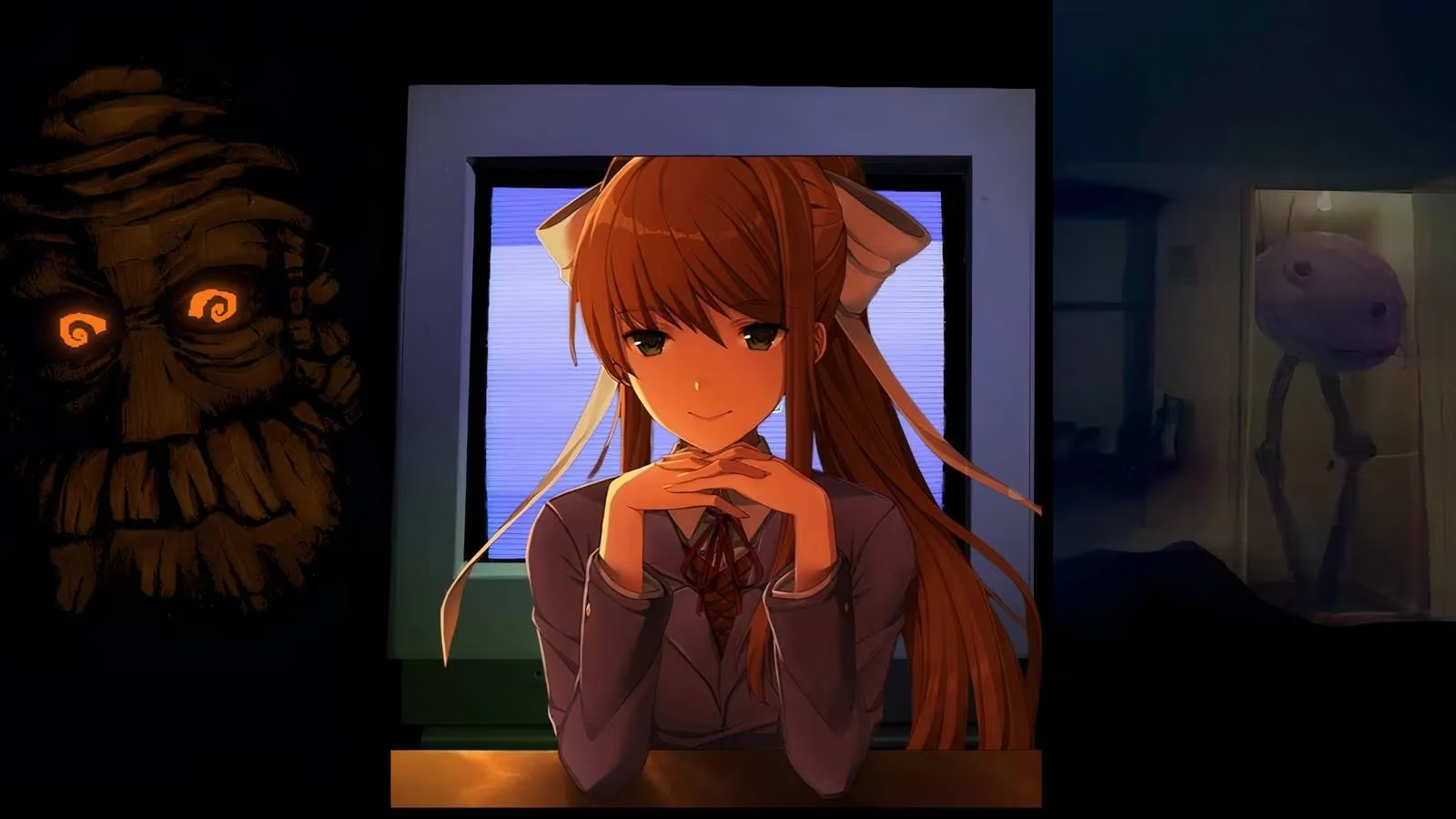
This title begins as the most stereotypical anime dating simulator imaginable, a deliberate facade that makes its subsequent descent into meta-horror all the more effective. Doki Doki Literature Club is a landmark in visual novel history, not for its romance, but for its ruthless deconstruction of the genre and its relationship with the player. The game's antagonist, Monika, becomes aware she is in a game and, in her quest for the player's attention, begins to corrupt the game world from the inside out. Files are deleted, characters are horrifically altered, and the game directly addresses the player's role in the tragedy. The opening content warning is not a suggestion; it is a necessary disclaimer for an experience that weaponizes player affection.
1. Undertale: The Game That Never Forgets
At the pinnacle sits Undertale, a game whose cultural impact and technical ingenuity have only grown since its release. Its brilliance extends far beyond its charming characters and innovative combat. Undertale possesses a remarkable memory. It doesn't just track choices within a single playthrough; it remembers actions across different save files and game resets. The game's infamous "Genocide Route" has consequences that persist, staining future playthroughs in subtle and overt ways. The act of showing mercy or dealing violence isn't just a moral choice; it's a permanent entry in the game's ledger. This creates an unparalleled sense of consequence, making the player feel truly responsible for the digital world they inhabit. It is the ultimate example of a game that treats its own existence as a persistent, living space, a sentient storybook that remembers every finger that turned its pages.
These eight titles represent a fascinating thread in gaming history—the pursuit of an experience that transcends its own code. They are not content to be mere simulations; they aspire to be events that happen to the player and their machine. As technology advances, the methods may change, but the core desire to break boundaries and create unforgettable, system-level illusions remains a powerful draw for developers and players alike in 2026.
0 Comments